


Reimagining Radiology from the Ground Up: A Conversation with Kate Kovalenko, Chief Product Officer at Sirona Medical
In a recent episode of The Imaging Wire Show, Brian Casey sat down with Kate Kovalenko, Chief Product Officer at Sirona Medical, to discuss how…
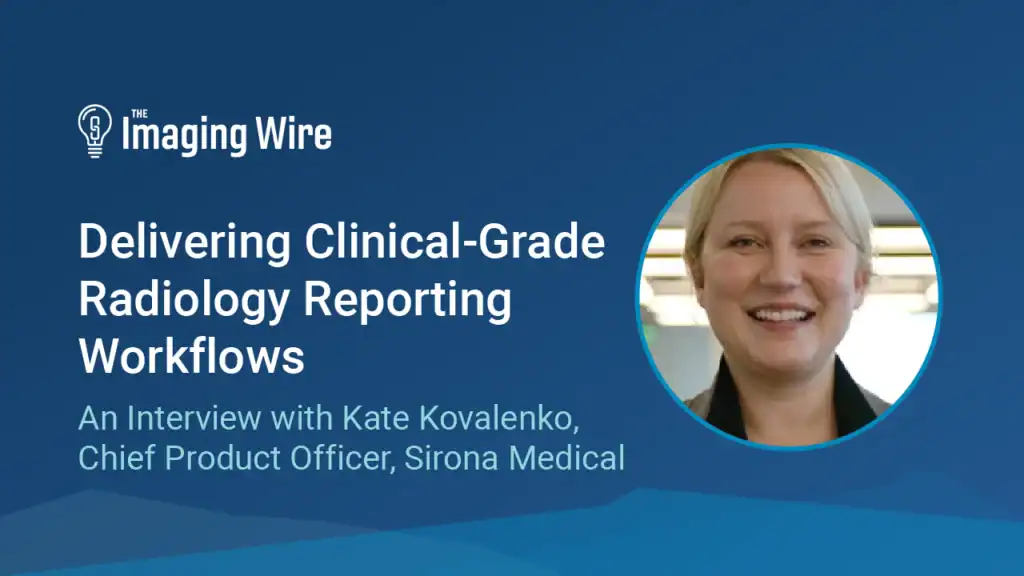
In a recent episode of The Imaging Wire Show, Brian Casey sat down with Kate Kovalenko, Chief Product Officer at Sirona Medical, to discuss how two decades in healthcare and radiology tech shaped her belief that imaging workflows needed a total rebuild.
What followed was a candid look at why legacy systems have reached their limits, why radiologists deserve better tools, and how Sirona’s cloud-native, unified platform is redefining what modern radiology truly means.
Kate’s path into radiology wasn’t planned; she joined a small Virginia startup working on early speech recognition for radiology. “I was employee number twelve at this startup,” she said. “It was sound and technology — I figured, let’s give it a shot. And I just fell in love with what tech could do for patient care and for clinicians.”
That spark turned into a career spanning over 20 years in healthcare technology, including leadership roles at Nuance, where she helped shape PowerScribe and the Precision Imaging Network before joining Sirona to help lead a complete reimagining of radiology’s digital infrastructure.
When Innovation Adds Friction
Looking back at the early days of speech recognition, Kate was blunt about the unintended consequences: “When we introduced speech recognition 20 years ago, we replaced transcription and made the radiologist’s life harder. We took their clinical assistant away and turned them into document editors.”
Despite good intentions, most innovations tend to add to the radiologist’s workload rather than reducing their burden. Each addition promised efficiency, yet delivered more clicks, more windows, and more frustration.
That pattern of fragmentation, viewers, reporting tools, and AI systems all living separately, made it clear that radiology didn’t just need better tools – it required a total rebuild.
Why Sirona Started Over
“Many companies have tried to create unified solutions by acquisition,” Kate said. “But when you bolt together multiple legacy apps — none of which are cloud-native — you can’t deliver innovation quickly or effectively.”
Instead of layering old systems, Sirona rebuilt everything from scratch. Its RadOS™ platform is designed as a single cloud-native operating system for medical imaging — unifying PACS, reporting, workflow, and AI from day one.
By owning the full stack, Sirona can deliver faster updates, greater performance, and seamless integration between images, reports, and data.
Building Alignment and Clinical-Grade Software
As CPO, Kate’s role spans product, design, engineering, and services, giving her a full view of where users struggle and how to fix it. She said, “Focus is everything. We look at what’s blocking a site from going live, where users struggle in training, and how that feedback should drive product improvement. It’s all one loop.” The goal, she says, is to deliver clinical-grade software that radiologists actually want to use.
Beyond Reporting: Pixel-to-Report
One of Sirona’s most transformative ideas is what it calls Pixel-to-Reporting™ — a workflow where image data, measurements, and annotations flow directly into structured reports automatically. “You can imagine a world where the report just disappears,” Kate said. “You’re looking at the images, asking questions, and the information moves into the report as a byproduct of your interaction with the pixels.”
This vision reframes reporting from a manual, text-driven task into a natural conversation between clinician and image, powered by agentic AI and large language models.
AI That Belongs In the Workflow
Katie was clear about why AI adoption has lagged in radiology: most tools are bolted on, not built in. “Legacy systems sold AI as add-ons, ” she said. But that meant extra subscriptions, extra clicks, extra friction. We don’t have to design that way.”
Sirona’s RadOS™ embeds AI directly into the platform, not as a separate module, but as part of the reading and reporting experience. Because the platform is fully API-driven, even third-party AI can integrate seamlessly. “Owning the full stack changes everything,” Kate said. “AI can finally work the way it should — intelligently, invisibly, and right where radiologists need it.”
Quality Assist and Agentic AI: The Next Frontier
Kate sees enormous potential for radiology assistants that truly support clinical work, thanks to large language modules. “We spent years turning radiologists into document checkers. The future is going back to giving them an assistant again — one that helps interpret, query, and summarize in real time, ” she said.
Sirona’s quality assist features use AI to spot inconsistencies and context errors in reports. At the same time, next-generation agentic AI tools promise interactive, conversational interfaces that let radiologists communicate naturally with their systems.
As RSNA approaches, Kate promises that Sirona’s presence will be rooted in proof, not prototypes. “Everything in our booth is production software — real systems treating millions of patients every year,” she said. “This isn’t futureware. It’s here, it’s live, and it’s making a difference.”
Check out the full interview on the Imaging Wire’s YouTube Channel.