


The Economics of Radiology in the Cloud: What RSNA 2025 Attendees Need to Know
Medical imaging is no longer a support function; it’s becoming the clinical heartbeat of modern care. Imaging is ordered in over 54% of ED visits…
Medical imaging is no longer a support function; it’s becoming the clinical heartbeat of modern care. Imaging is ordered in over 54% of ED visits and contributes to nearly 15% of all patient encounters.
This surge is driven by earlier disease detection, minimally invasive therapeutics, the prevalence of chronic diseases, precision diagnostics, and more. Yet, the infrastructure supporting these workflows was built for a very different era. The mismatch between demand and infrastructure is becoming economically unsustainable. For private practice groups, these new pressures include tightening margins, growing volume, capital-intensive IT requirements, and an increasingly competitive landscape dominated by national teleradiology firms. Health systems feel the same strain from the other side: rising demand, aging infrastructure, and staffing shortages.
The Hidden Cost of Fragmentation Is Draining
Most radiology departments are carrying more infrastructure than they ever intended to own. Radiology’s tech stack wasn’t designed; it just accumulated (badly) over time. And the economic burden of that accumulation now shows up in slower reads, longer backlogs, higher burnout, and recruitment challenges.
In a private practice with on-prem hardware, there are usually $250K–$500K in annual IT operating costs, a $500K–$1M capital refresh every 5 years, and IT staff tied up in upkeep, losing time to slow systems and friction. For health systems, the numbers scale even higher with estimates of $4–6M refresh cycles every 5–7 years and $1M+ in annual system maintenance.
Cloud-Native Radiology Resets the Economic Model
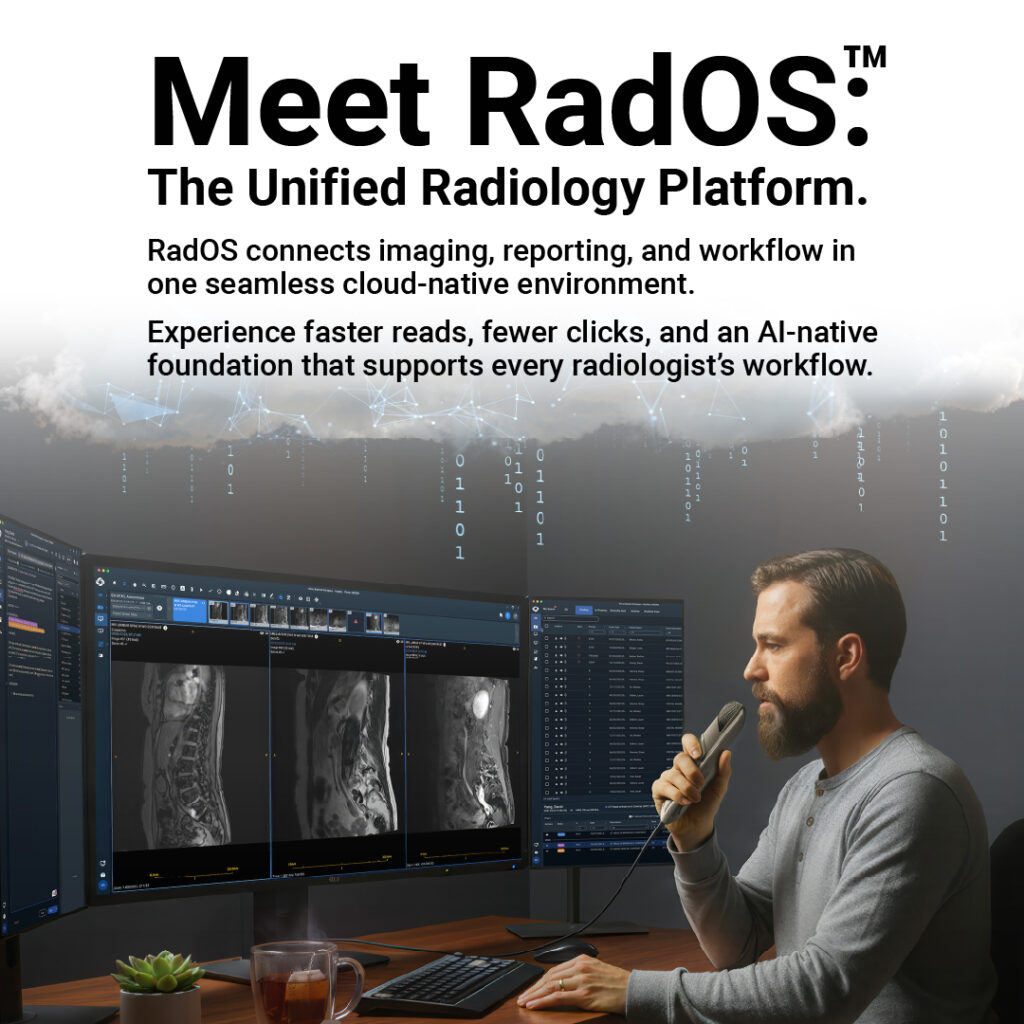
A unified, cloud-native radiology operating system consolidates PACS, reporting, workflow, voice, and collaboration into one environment. When that happens, three major economic shifts occur:
Fixed costs → Variable costs
Hardware, servers, storage, refresh cycles, and data center costs are all replaced by predictable usage-based pricing.
Rigid capacity → Elastic capacity
Groups can expand coverage, add new hospital contracts, and onboard remote radiologists instantly. Health systems can balance workloads across sites in real time; radiologist expertise no longer becomes tied to physical locations and becomes a fluid system resource.
Occasional upgrades → Continuous innovation
New capabilities (AI, analytics, workflow automation, etc) arrive without disruptive migrations or capital projects. This isn’t just modernization, it’s an economic inversion.
Why This Matters
For independent, physician-owned radiology groups, scale has long been an Achilles’ heel, as teleradiology firms gained an advantage by delivering nonstop coverage and rapid turnaround. Cloud-native radiology platforms neutralize that advantage by giving private practices 24/7 distributed coverage, nationwide recruiting reach, seamless remote reading without performance trade-offs, and the ability to take on new hospital contracts without adding servers, hardware, or IT staff. They gain enterprise-grade capability without enterprise-grade cost, along with a stronger negotiating position with hospitals. Dr. Luke Roller recently shared during a Sirona webinar that he gained a competitive advantage through the cloud. He said, “I started as a single radiologist, and with Sirona’s help, I now have contracts with some of the major health systems in the US. Through Sirona, I can easily partner with other radiologists to handle the excess volume I can’t cover, without incurring significant infrastructure investment.
And the same benefits hold for health systems: cloud-native infrastructure enables faster and more consistent turnaround times, access to subspecialty expertise across all sites (including rural or low-volume hospitals), and a dramatic reduction in total cost of ownership as onsite hardware and refresh cycles disappear.
What RSNA 2025 Attendees Should Watch Closely
As you walk through the exhibits and sit through demos, a few critical questions should anchor your evaluation:
Is the platform truly unified — or just cloud-hosted? True cloud-native radiology isn’t a PACS in the cloud; it’s a whole operating system. If you are worried that you’ll be offered in the cloud in disguise, check out our guide here.
Does the economic model eliminate capital expenditure? Predictable, usage-based pricing is a hallmark of fundamental cloud transformation.
Does it support remote reading? This is now a competitive necessity more than ever.
Can it improve TAT, backlog, and access to subspecialty care? If not, it’s not solving radiology’s main economic problem: demand-pressure imbalance.
The New Equilibrium: Radiology Unburdened
Radiology is entering a new economic era — one defined not by who owns the infrastructure, but by who can operate without being limited by it.
The economic foundation supporting radiology is shifting. Cloud-native, unified radiology platforms make fixed costs variable, capacity elastic, innovation continuous, and performance scalable. For health systems, this means lower total cost of ownership, flattened cost curves, and the ability to deploy radiologist supply where needed. For private practices, this means competing with national networks, recruiting remote talent, and expanding hospital contracts without servers and staff.
At RSNA 2025, don’t just look at the newest scanners or next-gen AI — look at the infrastructure that will enable them to scale, integrate, and deliver value. If you’re interested in learning more, Sirona will be exhibiting at RSNA (Booth 4569), where attendees can experience hands-on demonstrations of RadOS™ and learn more about how Sirona is redefining the modern radiology workflow.